Saving a down payment is a milestone. It is not the same as having the cash ready to buy a home.
For a purchase in Fremont, Newark, Union City or Milpitas, I want buyers to answer three different questions: What money will leave the account before closing? What remains due at closing? And what needs to stay available after the purchase?
Those questions matter whether you are considering a condo, a townhome or a detached house. The property, financing, contract and timing can all change the answer. A useful cash plan follows those details instead of treating one percentage of the price as the entire budget.
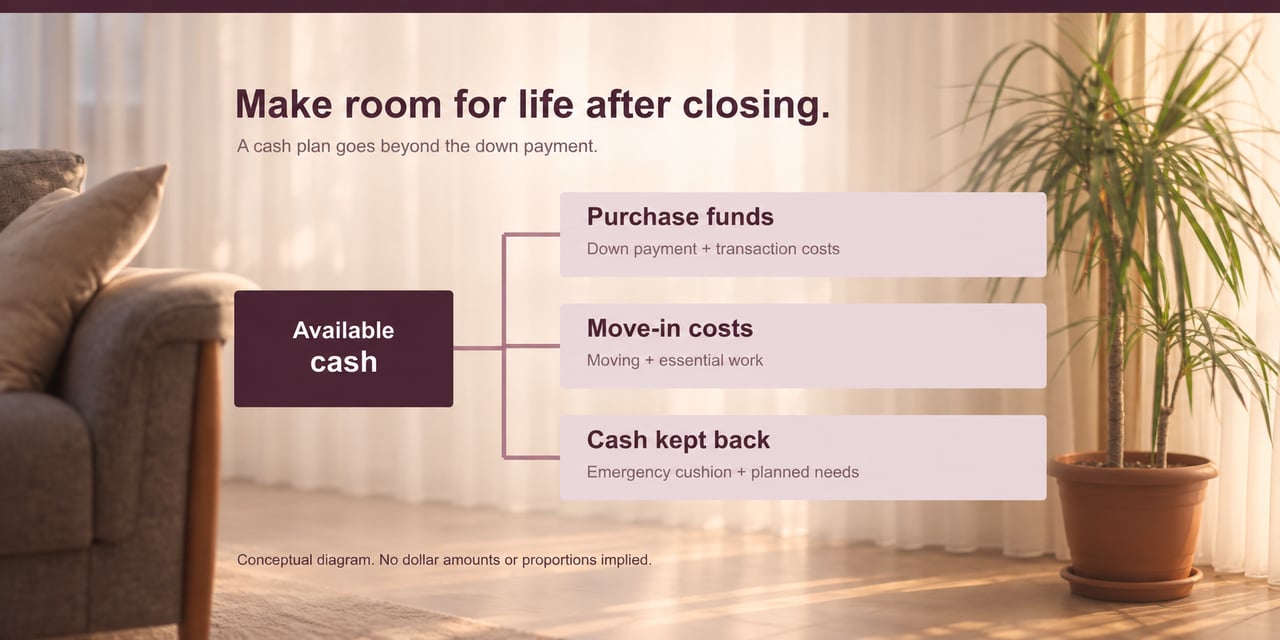
Plan the transaction cash and the money you want left afterward. Diagram is conceptual, not a dollar allocation or loan quote.
Start with the money you want to keep
Before choosing a down payment, identify the cash you do not want the purchase to consume. Think about an emergency cushion, moving expenses and work the home may need soon after possession.
The CFPB's down-payment planning guide uses this backward approach: set aside other needs before deciding what remains available for the purchase. Your priorities will be personal. Replacing a worn appliance is different from choosing new countertops, and neither should quietly erase your emergency cushion.
Your licensed lender may also require reserves. Those underwriting reserves are not necessarily identical to the cash you personally want accessible. Under Fannie Mae's reserve guidance, eligible assets are evaluated after subtracting funds needed to close. Requirements vary. Ask your lender which assets count and what must remain, rather than assuming every buyer needs the same number of months.
Separate the down payment from transaction costs
The down payment is your contribution toward the purchase price. Closing costs pay for other parts of the transaction. Depending on the loan and property, those may include lender charges, appraisal, title and escrow services, recording charges, and other agreed expenses.
Ask for an itemized estimate, not only a total. Review which charges are yours under the purchase agreement and any buyer-representation agreement. Do not assume a seller credit or another party's payment until it is agreed and accepted by the lender where required.
The CFPB's Loan Estimate explainer helps separate loan costs from other costs. Use your lender's actual disclosure and an escrow estimate for the property, then ask who will resolve each uncertain line. A preliminary estimate is a planning tool, not a promise that every amount is final.
Recognize costs that depend on the closing date
Some money collected at closing funds expenses in advance. Prepaid interest can cover part of a month. A homeowners insurance premium may be collected ahead of coverage, and an initial escrow deposit may establish funds for future tax and insurance payments.
These are different purposes, even when they appear together in the transaction totals. Tax prorations and other adjustments may also depend on timing. If the closing date changes, ask which figures need updating.
This is especially useful when comparing two homes with similar prices. An HOA property may involve association-related charges, while another home may need immediate work. Obtain the relevant documents, quotes and responsibility allocations for each address. There is no single Fremont, Newark, Union City or Milpitas fee estimate that substitutes for that review.
Count the deposit once—not twice
An earnest-money deposit is generally paid earlier in the transaction and credited toward the purchase at closing. It should not become an extra down payment in your personal calculation. Freddie Mac's upfront-cost guide explains how that deposit can apply to the down payment or closing costs.
Track the deposit date, amount, source account and receipt. Do the same for appraisal or other charges paid before closing. Then check that the final accounting treats those earlier payments correctly.
Deposit credit at a successful closing does not mean the deposit is always refundable if a purchase falls apart. That question depends on the contract and circumstances; obtain appropriate advice before making a commitment or changing protections.
Reconcile the amount still due
The final cash-to-close figure is not simply the down payment plus every number you see on the page. The accounting also reflects earlier payments, financing, credits and adjustments.
Use the CFPB's Closing Disclosure explainer alongside your actual documents. Ask the lender and escrow holder to explain the amount still due and any change from the earlier estimate. Do not add prepaids again if already included, or subtract the same deposit twice.
A simple cash log can use four columns: expense, expected amount, payment date, and whether it is already paid or still due. Keep move-in spending and retained savings outside the final amount being delivered to escrow. They belong in the overall plan, but they are not automatically part of the closing transfer.
Leave room for the first months of ownership
A closing statement does not replace a move-in budget. Consider movers, cleaning, utility setup, lock changes, essential repairs and any overlap with your current housing. Separate work needed promptly from improvements that can wait for quotes and a clearer view of your finances.
Also plan for possible supplemental property taxes. The California State Board of Equalization explains that qualifying ownership changes can generate supplemental bills in addition to annual property taxes. Check the correct county: Alameda County for Fremont, Newark and Union City; Santa Clara County for Milpitas.
Do not assume a mortgage impound account will handle that bill. Santa Clara County's FAQ explains that supplemental bills are generally sent to the owner and most lenders do not pay them from escrow. Verify the amount, timing and payment responsibility directly for your property; this is planning guidance, not tax advice.
Make the funds ready—and protect the transfer
Tell the lender early if the purchase relies on a gift, a transfer between accounts or money that is not yet available. Documentation requirements vary. Fannie Mae's gift guidance, for example, includes a signed gift letter and verification of funds or transfer. Do not assume every deposit is immediately usable.
Before sending closing funds, verify instructions with your escrow contact through a previously established phone number. An email changing the destination is a reason to stop and independently confirm, not to rush. The CFPB's closing-fraud guidance explains this precaution.
As a former mortgage loan officer and real estate agent with financing experience, I help connect these cash questions to the property search and transaction timeline. Your licensed lender handles loan qualification and terms. For ongoing affordability, see the monthly-payment guide; this checklist addresses the separate upfront-cash question.
Planning a purchase in the Tri-Cities or Milpitas? Let's organize your property, cash and timing questions before an offer makes them urgent.
Frequently asked questions
Is cash to close the same as my down payment?
No. The down payment is one part of the transaction. The remaining closing amount also reflects costs, financing, earlier payments, credits and adjustments.
Does my deposit count toward the purchase?
Generally, yes, when the purchase closes. Confirm the credit in the final accounting. Refundability if the transaction does not close is a separate contractual question.
Are my savings and the HOA's reserves the same thing?
No. Your retained funds support your own finances. An association's reserve fund belongs to the association and serves a different purpose.
Should I use every available dollar for a larger down payment?
Compare that choice with keeping cash for move-in needs, repairs and emergencies. Ask your lender how the alternatives affect qualification and terms; there is no universal right amount.
Photo credit: Background based on Beyzanur / Pexels; AI-assisted editorial composite.
Sources accessed: September 9, 2026; links rechecked September 10, 2026. Background photograph and Pexels license accessed September 10, 2026.