Why the Fed acted, what it means for Bay Area buyers and sellers, and how thoughtful financing can help you move forward.
When you hear that the Federal Reserve raised interest rates, your first reaction might be: “There goes my plan to buy a home.”
If you are selling, you might wonder whether buyers will disappear—or whether you need to lower your price immediately.
Those concerns are understandable. Higher borrowing costs affect real people, real budgets, and important decisions. But a headline does not tell you the whole story, and it should not make your housing decision for you.
Before deciding what to do, we need to understand three things: why the Fed acted, how this environment affects your move, and which options are actually within your control.
As a former mortgage loan officer and now a Bay Area real estate agent, that is where I want to help: connecting the economic news to practical decisions about your home, your finances, and your comfort.
Part 1: Why did the Fed raise rates?
Inflation is still the central problem
On September 16, 2026, the Federal Reserve raised its federal funds target range by one-quarter percentage point, to 3.75%–4.00%. The decision was unanimous. The Fed said inflation remained elevated and that the increase would support a return to its 2% goal. It also described a resilient economy, strong productivity, and robust investment. Read the Fed’s statement.
Inflation means prices are rising. A slower inflation rate does not necessarily mean groceries, insurance, or services return to their old prices; it means the pace of increases has slowed. For households, this creates a difficult combination: everyday life costs more, while borrowing can also become more expensive.
The Fed is trying to address persistent price pressure. Its interest-rate tool can make borrowing and spending less attractive, but that can also make a home purchase feel harder today. Understanding that tradeoff is more useful than treating the announcement as simply good news or bad news.
What Kevin Warsh emphasized
Chair Kevin Warsh described an economy with solid employment and improving investment, while saying recent inflation readings had not shown enough underlying improvement. His explanation was not that every part of the economy was weak. Rather, economic resilience gave the Fed room to act against inflation.
He also distinguished individual price shocks from persistent, economy-wide inflation. The Fed cannot directly set oil or grocery prices. Its concern is that price increases in one area spread into others and become harder to bring under control. He declined to commit to future decisions. Read the official press-conference transcript.
Where war, energy, and tariffs fit
The backdrop includes war-related energy disruption and tariff pressures, as discussed in Reuters’ September meeting coverage. These are different forces, and they do not affect every business or household equally.
More expensive energy can raise transportation and production costs. Tariffs can increase the cost of some imported goods and inputs. Businesses may absorb some of those costs, change suppliers, or pass some along to customers. It is not necessarily a dollar-for-dollar increase in every retail price.
A rate hike cannot reopen a shipping route or remove a tariff. What it can influence is the broader borrowing and spending environment. The concern is whether initial shocks become persistent price pressure through the wider economy. Strong investment also creates demand for resources, even when that investment may support productivity over time.
Does this mean more hikes are coming?
Another increase is a possibility—not a promise. September’s median Fed projection puts the policy rate at 4.1% at the end of 2026 and again at the end of 2027. The 2026 figure is consistent with another quarter-point increase from the new range, but the 2027 median does not imply continuing annual increases. These are policymakers’ assessments, not a guaranteed path or a direct measure of market expectations. See the September projections.
That distinction matters for your housing plan. I would not assume either that rates must keep rising or that a future cut will rescue an uncomfortable payment. A sound decision leaves room for more than one outcome.
Part 2: What does this mean for buyers and sellers?
Mortgage rates are near 7%—but the Fed does not set your mortgage quote
Freddie Mac’s September 17 weekly survey reported an average 30-year fixed mortgage rate of 6.95%, compared with 6.76% the previous week. That is a national survey average, not a personal quote, and the entire weekly change should not be attributed to a single day’s Fed announcement. Check Freddie Mac’s mortgage survey.
The Fed sets a short-term policy rate. A 30-year mortgage also reflects longer-term bond yields, inflation expectations, and mortgage-market pricing. Markets can anticipate a decision before it happens. A quarter-point Fed increase does not automatically add a quarter point to every mortgage quote. The Atlanta Fed explains the distinction.
Your credit profile, loan size, down payment, property, points, and lock terms also matter. Ask your lender for updated figures. If you already have a fixed-rate mortgage, the announcement does not itself change your contractual principal-and-interest payment, although taxes and insurance can change. Adjustable-rate loans require a review of their reset terms. See the CFPB’s payment guidance.
Higher rates can reduce purchasing power
Here is a hypothetical illustration—not an available loan offer. On an $800,000, 30-year fixed loan, principal and interest would be approximately:
Illustrative note rate | Monthly principal and interest |
|---|---|
6% | $4,796 |
7% | $5,322 |
That is about $526 more each month, or $6,312 a year, before other housing expenses. Keeping the same principal-and-interest budget as the 6% example would support a loan of roughly $721,000 at 7%, rather than $800,000.
Assumptions for all worked examples, dated September 17, 2026: $1,000,000 purchase price; 20% down ($200,000); $800,000 loan amortized over 30 years; hypothetical fixed note rates as labeled. Property taxes are assumed at 1.25% annually ($1,041.67 monthly), homeowners insurance at $200 monthly, HOA dues at $0, and mortgage insurance at $0. Ordinary closing costs and prepaids are illustratively $20,000, separate from the down payment and any buydown subsidy. No discount points or additional buydown fees are modeled. These are not lender quotes or APR disclosures for an offered loan. Actual costs and qualification depend on credit, documented income, debts, assets, reserves, property, program, and lender requirements. Utilities, maintenance, and repairs are additional.
Should you wait?
Waiting can be the right choice if it allows you to save, reduce debt, or clarify your plans. Buying a home that does not fit your budget is not the solution to uncertainty.
But waiting solely for a perfect rate is not a complete strategy. Rates, prices, inventory, and your personal circumstances can all change. A lower rate later does not guarantee that the same home will be available at the same price. Equally, buying now does not guarantee appreciation.
In the Bay Area, AI-related employment and wealth are another part of the conversation—but not a reason to assume every neighborhood will rise. Redfin’s research describes uneven trends, especially around San Francisco luxury housing, and does not establish that AI alone caused price changes. Meanwhile, C.A.R.’s August report showed the Bay Area regional median down 0.2% year over year. A regional median is not a valuation of your particular home.
The practical question is not “Will the entire Bay Area go up or down?” It is “What are the choices for the specific home, location, condition, and payment that work for me?”
For sellers, the buyer’s payment deserves attention
A buyer may love your home but struggle with its monthly cost. That does not automatically mean you must cut the price immediately, but it does mean pricing and terms need to reflect today’s competition.
Review comparable sales, active alternatives, condition, presentation, and actual buyer feedback. A useful concession can address a financing obstacle. It cannot replace realistic pricing or necessary preparation. If you are selling and buying, evaluate your expected net proceeds and next payment together.
Part 3: Solutions—focus on payment comfort and what you can control
Start with a comfortable payment, not the maximum approval
A lender’s approval and your personal comfort limit are not the same thing. Include principal and interest, taxes and assessments, insurance, HOA dues, and mortgage insurance where applicable. Then leave space for utilities, maintenance, repairs, savings, and ordinary life.
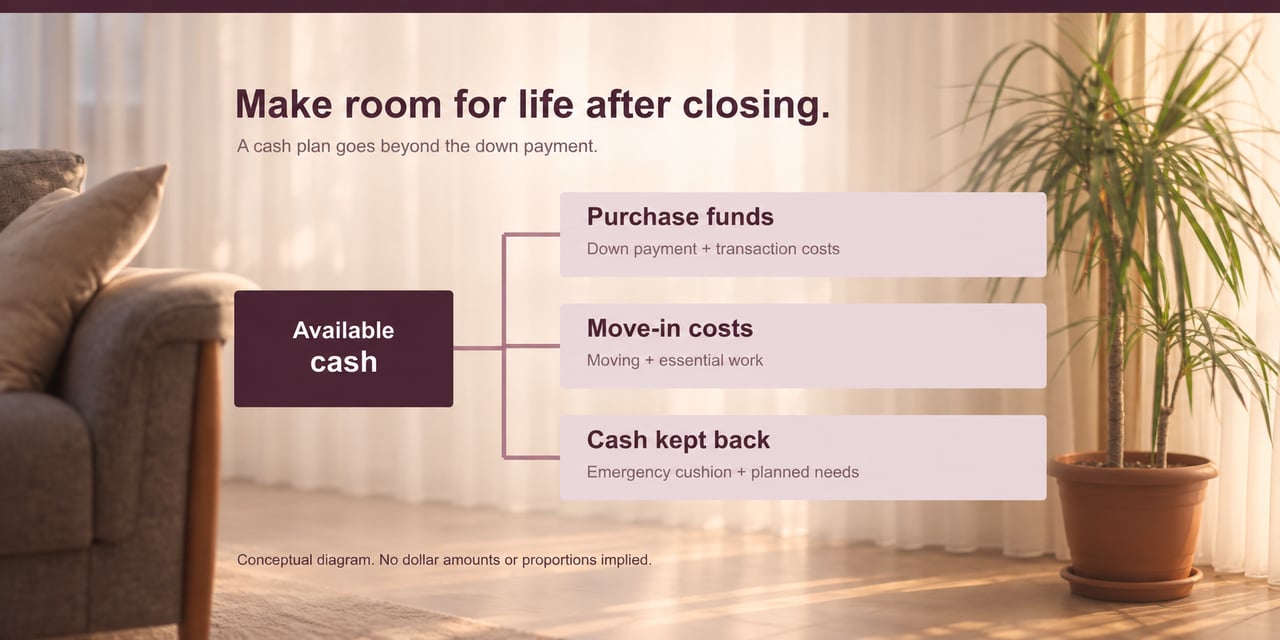
Protect the cash you will have after closing, too. A payment can appear manageable while closing costs, moving, and immediate repairs leave too little cushion. The plan should not require every month to go perfectly.
What is a temporary buydown?
A temporary buydown is a funded subsidy that reduces the borrower’s payment contribution for a limited period. On a fixed-rate loan, it does not change the note rate. The subsidy makes up the difference between the borrower’s reduced contribution and the scheduled principal-and-interest payment.
A 2-1 arrangement calculates the borrower’s contribution using a rate two percentage points below the note rate in year one and one point below in year two. A 3-2-1 adds an initial year calculated three points below the note rate. The full payment follows when assistance ends.
Funding may come from an eligible seller, builder, or other permitted source, depending on the program. Under Fannie Mae’s guidelines, borrowers qualify at the note rate; contribution limits and eligibility rules apply. Ask your lender about the particular loan, especially if it is jumbo. Review Fannie Mae’s buydown guidance.
A 2-1 buydown example
Using the $800,000 loan and hypothetical 7% fixed note rate above:
Period | Rate used to calculate contribution | Borrower’s monthly P&I | With assumed taxes and insurance |
|---|---|---|---|
Year 1 | 5% | $4,295 | $5,536 |
Year 2 | 6% | $4,796 | $6,038 |
Years 3–30 | 7% | $5,322 | $6,564 |
The first-year reduction is approximately $1,028 monthly, followed by about $526 monthly in year two. Funding those differences requires approximately $18,646 upfront, excluding any additional fees. Calculations use unrounded amounts; displayed figures are rounded.
This is not free money or a permanent 5% mortgage. Someone funds the assistance, and the lender must approve its structure and source.
A 3-2-1 buydown example
On the same hypothetical loan:
Period | Rate used to calculate contribution | Borrower’s monthly P&I | With assumed taxes and insurance |
|---|---|---|---|
Year 1 | 4% | $3,819 | $5,061 |
Year 2 | 5% | $4,295 | $5,536 |
Year 3 | 6% | $4,796 | $6,038 |
Years 4–30 | 7% | $5,322 | $6,564 |
The estimated subsidy is approximately $36,684, before additional fees. The extra year of assistance requires substantially more funding. Availability is not established by this example.
Both tables hold taxes and insurance constant only for illustration; actual bills can change. The subsidy does not reduce them. HOA dues and mortgage insurance are assumed to be zero, and maintenance and other living costs remain additional.
The buyer benefit—and the test that matters most
Temporary assistance can provide breathing room after a move. But in this example, the most important number is the full modeled housing cost of approximately $6,564 per month, not the first-year payment.
Would that amount still fit without a refinance, a raise, or appreciation? If not, temporary assistance may be hiding a problem rather than solving one. Review the written payment schedule and ask how unused subsidy funds are handled if you sell or refinance early; do not assume they become cash back to you.
How a seller can use this option thoughtfully
A seller-funded buydown may make an eligible offer more appealing by addressing initial payment concerns. Compare it with a price adjustment and other credits, using actual lender-approved terms and your net proceeds.
For illustration, a $20,000 price reduction with 20% down reduces the loan by $16,000. At the hypothetical 7% rate, that lowers principal and interest by about $106 monthly for the loan’s remaining scheduled term. It also lowers the required down payment by $4,000; taxes and some transaction costs may differ.
By comparison, approximately $18,646 toward the modeled 2-1 subsidy creates much greater initial relief, but that relief expires. These are not identical outcomes, and the smaller introductory payment does not automatically make the buydown the better deal.
A seller should weigh usable concessions, appraisal considerations, buyer needs, and net proceeds. A buydown does not guarantee a faster sale or a higher price.
Compare the alternatives on the same page
Ask your lender to compare eligible closing-cost credits, permanent discount points, a temporary buydown, and a different purchase price or down payment. Include cash needed now, the full future payment, total cost over your expected ownership period, and reserves left afterward. Sometimes the better solution is a less expensive home or more preparation—not a more complicated loan structure.
Control what you can control
My message is not “ignore interest rates” or “everyone should buy now.”
It is this: understand the environment, understand your options, and make the decision with real numbers.
You cannot control the Fed, the war, tariffs, or the next inflation report. You can control how you prepare, what you buy, how much you commit each month, and which terms you explore.
If you are buying or selling in the Tri-City area, Milpitas, San Francisco, or San Mateo County, I can help connect the property decision with the financing and timing questions to review with your lender.
Sometimes that means moving forward with a better structure. Sometimes it means adjusting the plan first.
Either way, the goal is the same: a decision you understand and a homeownership plan you can comfortably live with.
Austin Cheng | Sequoia Real Estate | CA DRE #02050279
Educational information as of September 17, 2026. Sources linked above were accessed September 17, 2026. This is not an offer to lend, a personalized financing recommendation, or legal or tax advice. Austin is a former mortgage loan officer and provides real estate services, not current loan origination. Obtain actual rates, APRs, fees, eligibility, and concession limits from your lender. No refinancing, qualification, rate, sale-price, or timing outcome is guaranteed.